
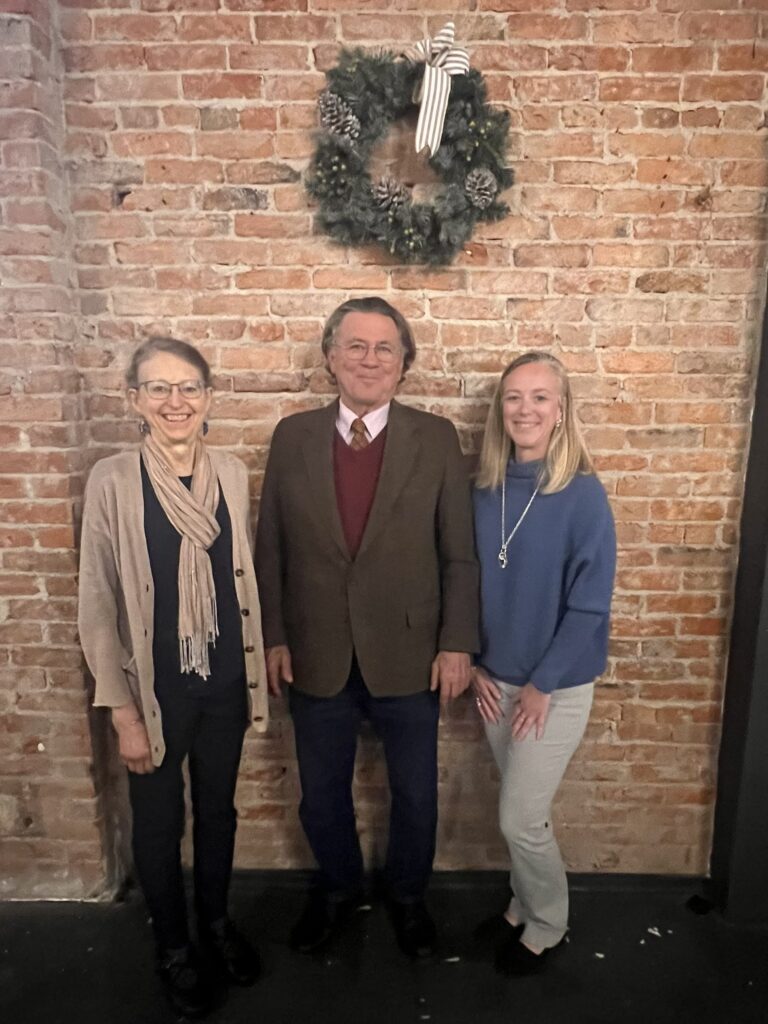
At the Main Street Nevada Annual Meeting celebration, Tom Richards was recognized for the award he won earlier this year – Excellence in Archaeology and Historic Preservation – for his meticulous work on The Nevada Journal Building. Tom received this award at the State Historical Society Museum in Des Moines.
Remarks from Tom on his award:
When I went down to Des Moines to receive the 2025 Iowa Historic Preservation Award I had a little speech ready just in case. But at the ceremony the podium was on one side of the stage and they presented the certificates over on the other side of the stage. So there was no chance to speak. So here goes.
There were five of us receiving awards. The Journal was the only building recognized. There were two books, a scholarly article published in ‘the Iowa History Journal’ or some such. And then there was a lifetime achievement award given to this white haired old guy they called Ambassador Quinn.
Ambassador Quinn got his award and walked across the stage and took the microphone. So I already liked him. He talked about having been US Ambasssador to Cambodia and said a couple of things that really stuck with me.
As he spoke, I realized I had heard him a couple of years previous. I was playing in the Barn Owl Band and we were hired to provide dinner music down at Living History Farms for their fall fund raising banquet. Ambassador Quinn was the after dinner speaker. So I was kind of a mouse in the corner for his speech. I felt privileged. I thought to myself later that he was the greatest man I had ever been in the same room with. It was a powerful talk that he gave.
As it happened, the fundraiser was marking the 50th anniversary of Pope John Paul II’s visit to Living History Farms. Something like 350,000 people came to see him that day. Ambassador Quinn was among the crowd, working at the time as a young staffer for then Governor Robert Ray.
Quinn recalled the moment at the end of Pope John Paul’s homily to the crowd. The sun was beginning to set and the Pope raised his arm over the people there and blessed them. Then he gave them a charge. “Feed the world,” he said.
Quinn said that he, like the crowd standing there, was transfixed by the moment. And then just as suddenly he heard the other staffers yelling at him to “get in the car” because they had to get Gov. Ray off the grounds before that crowd started moving toward the gates.
Quinn next spoke about Governor Ray’s involvement with resettling “boat people” from Southeast Asia fleeing the communist takeover of their countries. A boat load of refugees had been famously refused entrance to a US port and their boat had sunk with many of them losing their lives. Ray led the grass roots state effort to reopen the refugee resettlement program so that more people could come here.
A few years later things went bad again in Southeast Asia and once again Governor Ray stood up to lead an effort to provide relief for people in Asian refugee camps. Quinn was involved as a staffer, and was the one who came up with the name Iowa SHARES that stands for Iowa Sends Help to Aid Refugees and End Starvation.
In later years Quinn was made US Ambassador to Cambodia and served there until the year 2000. He retired from that position to become President of the World Food Prize. It was in this role that he addressed the audience at Living History Farms that evening. He told this story of Governor Ray’s global leadership, Pope John Paul’s visit and his own career involved with the work of those two great people. A few weeks later he announced he was retiring from the World Food Prize, so we were hearing, unawares, his summation of his career. It was quite a speech.
Then when I heard him speak recently at the State awards ceremony it took me a few moments to figure out who he was. This time his remarks were brief. He stressed for us how important it is to work to find common ground between and among warring factions. It’s an attitude and also a set of skills. It struck me as particularly good advice in today’s world.
When I try to apply that to the things going on around me I chuckle a little bit. When you talk about common ground around here you are talking about the good black earth beneath our feet. Most of us have some kind of connection to the soil. For me it’s the cemetery up in Webster City where my great grandfather and several of his children lay. There is a similar, smaller cemetery out in south central Nebraska that I hope to visit again. And a monument down in Wellman where my grandmother’s parents lay. Farmers, teachers, harness makers, journalists. All part of building the Iowa that existed a century ago.
That Iowa was made up of small 80, 120, 200 acre farms, 6 or eight of them on every square mile, 1 or two places on each side of every mile of gravel road out there. Country schools, country churches, a whole vibrant community living out there connected to the soil. A network of small towns existed to serve this community. You can see the prosperity of the times reflected in the Main Street and public buildings as well as grand mansions on the edges of small towns.
When I look at a beat up old building, maybe one in a small town with the glass broken out of the 2nd floor windows and pigeons flying in and out, I see the the remains of a good Iowa where families throve together and the wealth of our state was spread out across the land. The Iowa of my parents and grandparents. I feel a deep connection to them through these old main street buildings. It is as though they might have walked through these same doors. Done business with gold and silver coins at their counters.
I think a lot of people share this same feeling although they might not describe it the same way. More of just a sense of authenticity and belonging when they are on Main Street. People certainly respond to the invitation to visit downtown; Halloween, Christmas, Lincoln Highway Days, 4th of July, Homecoming. A victory parade! They love to bring their kids downtown. They love to be downtown.
These are some of the things that draw me toward Historic Preservation.
I will put a final footnote of a different nature on this narrative.
The Journal Building is 1700 square feet on the main floor. We improved the lower level into another 1700 square feet of usable office space. So we have 3,400 square feet of space. It has all completely new wiring, plumbing and mechanical equipment. The electrical is all new trenched in from a nearby pole. The all new plumbing connects to brand new underground city pipes. In addition the building has all new windows and doors with the exception of one old historic 4′ x 8′ wood double hung that has been restored and two 20 year old Marvin wood double hungs I installed back when. The interior finishes are all new.
We zoomed past our original projected cost going full speed. We stopped tallying at $750,000, which is what we are saying is the amount we have in the building. Using those numbers, we have a newish building for $220 per square foot. Way too expensive. So then you take out the Challenge Grant and the City of Nevada grant, and it drops down to $170 per square foot which is where we are now. Still way too expensive. I hope to receive the Iowa State tax credit this following year. If we receive the full 25% of $750,000 that will bring the out of pocket cost down to $120 per square foot which is pretty good. I am not a rich man so I will not be able to use the whole federal tax credit, and it dribbles in over a five year window at 20% a year. But counting that full 20% credit, the cost for the Journal Building project drops down under $90 per square foot for a prize winning building. That is a number that should not be overlooked by people undertaking renovations and alterations of these historic downtown buildings. I have learned a lot about the tax credits and their accounting requirements. Had we known this ahead of time, we would have the credits already.
Historic Preservation is not just a touchy feely thing. Given the current incentives it is also good business practice.